
Discover how modern dredging deepens channels, builds new terminals, and keeps ports competitive worldwide—while meeting environmental rules and budgets.
A container ship can cross an ocean in two or three weeks, but it can lose that advantage in a single tide. If a channel is too shallow by even a small margin, a vessel may have to wait for high water, reduce cargo (light-load), or divert to another port. That is why dredging—often described as “underwater excavation”—sits quietly underneath the loud headlines about mega-ports, supply chains, and record ship sizes. When dredging is done well, ships arrive on schedule, terminals stay productive, and trade flows. When it falls behind, ports become less reliable, freight costs rise, and cargo owners re-route.
Modern dredging is no longer only about removing mud and sand. It is a combined discipline of hydrographic surveying, geotechnical understanding, environmental permitting, sediment management, and industrial project delivery. In practice, dredging is one of the few port investments that touches every part of maritime logistics: navigational safety, berth productivity, vessel economics, and environmental compliance.
Why This Topic Matters for Maritime Operations
Global seaborne trade is the backbone of the world economy, and ports compete in an environment where reliability matters as much as capacity. A port can have modern cranes and a large yard, but if access depth is uncertain, shipping lines must plan around tidal windows, cargo limitations, and schedule risks. Dredging improves “draft reliability,” which directly supports safer navigation, fewer delays, and better use of port assets—especially as vessels become larger and schedules tighter.
Key Developments, Technologies, and Practical Applications
Capital dredging vs. maintenance dredging: the two jobs ports cannot confuse
Ports typically face two different dredging realities.
Capital dredging is the big, transformational work: deepening an access channel, enlarging a turning basin, creating a new berth pocket, or forming new land through reclamation. It is closely tied to port expansion strategies, new terminal developments, and long-term competitiveness. The engineering challenge is often geotechnical (hard layers, rock, varying soils), while the governance challenge is permitting and public acceptance.
Maintenance dredging is the continuous operational requirement: keeping channels and berth pockets at their design depths as natural sedimentation refills them. Many ports experience sedimentation as a predictable “tax” of their geography—river mouths, estuaries, and tidal systems continuously move material. Maintenance dredging is therefore less about expansion and more about reliability: it protects the port’s published depth and avoids the slow decline into tidal restrictions.
This distinction matters because trade disruptions rarely come from a port that never expanded; they often come from a port whose depth reliability quietly degraded over time.
Why bigger ships raise the value of dredging—without making it optional for every port
Ship upsizing is not a simple “bigger is always better” story, but it helps explain why many ports invest in deepening. Larger vessels seek economies of scale and, on some routes, lower emissions per container on the sea leg. At the same time, they concentrate operational risk at the port call: a single delayed ultra-large call can distort yard planning, gate flows, and schedule recovery across an entire service network.
This is where dredging becomes a strategic enabler rather than a maintenance expense. A deeper channel can reduce tidal dependence and allow heavier loading, which improves schedule certainty and lowers the per-unit cost of transport. That is why port expansion discussions are rarely only about cranes and yard area; they often start underwater.
Modern dredging fleets: choosing the “right excavator” for the seabed
Dredging vessels are specialized industrial platforms, and their capabilities matter because seabeds are not uniform. Ports typically use or contract multiple dredger types depending on material, site constraints, and production targets.
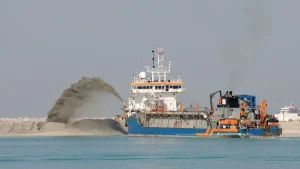
Trailing Suction Hopper Dredgers (TSHDs) are self-propelled vessels that suction sediment through dragheads and store it in an onboard hopper. They are especially valuable for maintenance dredging and large-scale sand dredging for reclamation because they can work in open water and move material efficiently.
Cutter Suction Dredgers (CSDs) use a rotating cutterhead to loosen material and pump it through pipelines. They are often chosen for more compact soils, clays, or where pipeline delivery to placement sites is operationally efficient.
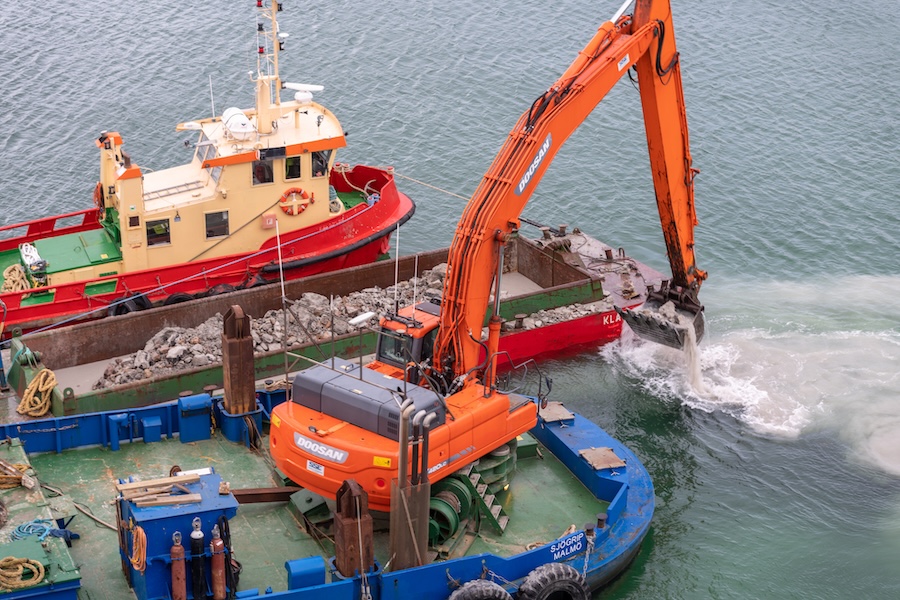
Mechanical dredgers (such as backhoe and grab dredgers) are used where precision is critical—near structures, in confined basins, or where sediments must be carefully controlled. Modern sealed grabs and environmental buckets reduce sediment spill, which is important in sensitive areas.
From a port-operations perspective, the key concept is “production under constraints.” A dredger is only productive if it can work safely in traffic, meet turbidity limits, cope with weather windows, and deliver material to an approved placement route without bottlenecks.
Survey, positioning, and digital control: dredging is increasingly “measure-first” engineering
A modern dredging project is governed by measurements more than assumptions. High-resolution hydrographic surveying—commonly using multibeam echosounders—enables accurate pre-dredge volume estimates, real-time progress verification, and final acceptance surveys. Dense seabed mapping reduces over-dredging, improves contract clarity, and provides transparent evidence for payment and compliance.
Think of it like painting a wall. If you can see exactly where the paint is thin, you do not waste paint covering the same area again and again. In dredging, better measurement means less wasted fuel, fewer reworks, and fewer disputes.
Dredged material management and “beneficial use”: turning a disposal problem into a port asset
In older approaches, dredged material was often treated mainly as waste. Modern sediment management increasingly treats it as a resource, provided quality is understood and placement is controlled.
Beneficial use can include land reclamation, beach nourishment, habitat creation, and coastal resilience projects. When ports reuse suitable sediments locally, they may reduce disposal costs and create additional terminal land or shoreline protection. This can be especially valuable where land is scarce or coastal erosion is becoming a serious threat.
However, beneficial use requires disciplined sediment characterization. Not all dredged material is suitable for reuse, especially if it contains contaminants from historical industrial activities. In those cases, secure placement and long-term management may be required.
Environmental governance: dredging is now a regulated environmental activity, not just marine construction
Dredging interacts with water quality, habitats, noise, and contaminant pathways. This is why environmental governance frameworks have become central to modern dredging. Ports often need to demonstrate that impacts will be minimized, monitored, and managed.
Environmental requirements commonly focus on:
-
limiting turbidity and sediment plumes,
-
protecting sensitive habitats such as seagrass and coral,
-
avoiding critical breeding or migration periods for marine life,
-
managing underwater noise where relevant,
-
preventing the spread of invasive species through sediment movement.
For many ports, the practical reality is that environmental compliance is not a final checkbox; it shapes the dredging method, schedule, placement plan, monitoring design, and total cost.
Classification and assurance: why “dredgers are ships” still matters
Even though dredgers are purpose-built industrial units, they remain ships operating in complex environments. Classification and marine assurance practices address vessel stability, structural safety, dredging system integrity, and operational risk controls.
This matters to ports because dredging campaigns often run in busy navigation areas. Equipment reliability, redundancy, and safety management affect not only the contractor but also port traffic management, incident risk, and continuity of trade flows.
Challenges and Practical Solutions
Modern dredging is one of the strongest enablers of trade, but it is also one of the most constraint-heavy port activities.
Sediment uncertainty remains a major risk. Even with strong surveys, seabed conditions can vary sharply. Ports reduce this risk by combining geophysical surveys, geotechnical sampling, and staged plans that allow adaptation if unexpected layers appear.
Environmental windows can compress schedules. Seasonal restrictions and monitoring thresholds can reduce workable days. A practical response is to sequence work zones intelligently and use low-impact methods in sensitive areas, supported by real-time monitoring that allows operations to continue when conditions remain within limits.
Placement capacity is often the hidden bottleneck. Projects can stall if placement sites are distant or disposal options are limited. Ports increasingly address this by integrating beneficial use pathways and planning placement logistics early, not after dredging begins.
Traffic management and safety become more complex during dredging. Successful ports treat dredging like a live operational interface with pilots, terminal planners, and vessel traffic services, using clear communication protocols and well-defined safety zones.
Cost escalation is frequently driven by mitigation, monitoring, and stakeholder complexity rather than only dredging volume. Early engagement, transparent reporting plans, and credible environmental management often reduce delays better than last-minute technical changes.
Case Studies and Real-World Applications
Large channel-deepening projects illustrate how dredging can convert tide-dependent operations into schedule-dependent operations, improving reliability for shipping lines. In practical terms, deeper access allows vessels to load closer to optimal draught and reduces the need to wait for high tide. This improves berth planning, reduces voyage uncertainty, and helps ports attract and retain services.
Major land reclamation programs show another pathway: dredging does not only remove seabed material; it can create new port geography. Where ports lack land, reclaimed terminal platforms built from suitable sediments become a long-term capacity solution, enabling new berths, yards, and logistics zones.
In both cases, the consistent pattern is that dredging supports trade not as a stand-alone activity, but as part of an integrated system linking navigational access, terminal productivity, environmental compliance, and long-term planning.
Future Outlook and Maritime Trends
Dredging will likely become even more central as climate change reshapes sedimentation patterns and sea levels rise. Many ports will face more frequent siltation, stronger storm-driven sediment movement, and greater pressure to raise terminal levels for resilience. This increases the value of long-term sediment management strategies rather than reactive campaigns.
Digitalization will continue to expand. Predictive models and “digital twins” of port basins will help ports forecast where sediments will accumulate and plan dredging more efficiently. Automation and hybrid power systems may reduce emissions and operating costs, especially in ports that adopt shore power and stricter air-quality rules.
At the same time, social acceptance will matter more. Ports that can demonstrate transparent monitoring, responsible sediment handling, and beneficial use outcomes will find it easier to secure permits and maintain public trust.
FAQ Section
1) What is the difference between capital dredging and maintenance dredging?
Capital dredging changes port geometry or depth—deeper channels, wider basins, new berth pockets, or reclamation. Maintenance dredging keeps those design depths from filling in again due to natural sedimentation.
2) Does dredging always mean environmental harm?
Not necessarily. Dredging can impact ecosystems, but modern methods and controls aim to minimize turbidity, avoid sensitive seasons, and manage sediments responsibly. The quality of planning and monitoring often determines the real outcome.
3) Which dredger type is best for ports?
It depends on sediment type, space constraints, and production needs. TSHDs are common for large-volume work and maintenance; CSDs are effective for tougher soils and pipeline delivery; mechanical dredgers excel in confined, precision areas.
4) Why do ports dredge if they already seem deep enough?
Because reliability is the goal. Even small depth losses can create tidal restrictions, reduce allowable cargo, or increase grounding risk. Dredging protects published depths and keeps port operations predictable.
5) Can dredged material be reused?
Often yes, if the material is suitable and clean enough. Reuse can support land reclamation, beach nourishment, or habitat projects. If material is contaminated, secure placement and containment may be required.
6) What factors drive dredging costs the most?
Material type (sand vs clay vs rock), distance to placement sites, environmental mitigation, monitoring requirements, traffic constraints, weather downtime, and permitting complexity often drive cost more than pure volume.
7) How does dredging support global trade directly?
Dredging keeps ports accessible to modern ships, reduces delays and cargo restrictions, supports expansion of terminals through reclamation, and improves schedule reliability across supply chains.
Conclusion and Take-away
Modern dredging supports global trade by protecting the most basic requirement of maritime logistics: safe, reliable access to ports and waterways. It keeps channels and berth pockets at workable depths, reduces tidal dependence, and enables ports to expand through deepening and land reclamation. At the same time, dredging has become more regulated and more accountable, shaped by environmental expectations, monitoring requirements, and careful sediment management.
For maritime professionals, the key takeaway is to treat dredging as a strategic operational system, not a one-off construction task. When ports integrate accurate surveys, smart equipment selection, responsible sediment pathways, and transparent compliance planning, dredging becomes a competitive advantage—one that improves reliability for ships, strengthens port capacity, and supports long-term growth in global trade.
References
-
International Maritime Organization (IMO). Conventions and guidance related to marine environmental protection and dumping at sea.
-
London Convention & London Protocol. Guidance on the assessment and management of dredged material.
-
International Chamber of Shipping (ICS). Port–ship interface and operational considerations.
-
IACS (International Association of Classification Societies). Classification and safety frameworks relevant to specialised vessels.
-
EMSA (European Maritime Safety Agency). Maritime safety and environmental support resources in Europe.
-
UNCTAD. Review of Maritime Transport and port development context.
-
World Bank. Port development, trade facilitation, and infrastructure investment perspectives.
-
PIANC. Technical guidance on dredging and environmental management.
-
OSPAR and HELCOM. Regional guidance on dredged material management (where applicable).
-
Peer-reviewed journals: Marine Policy, Marine Pollution Bulletin, Journal of Maritime Affairs.