
Explore the global leaders in dredging, from European giants to Asian powerhouses. This guide analyzes their specialized fleets, landmark projects, and the technologies shaping the future of maritime infrastructure.
The Invisible Foundation of Global Trade
Beneath the surface of the world’s busiest harbors, along its evolving coastlines, and across vast land reclamation sites, a massive, often unseen industry operates. Dredging—the process of excavating and moving underwater sediment—is the silent enabler of global commerce and coastal development. It ensures that the largest container ships can reach port, that coastal communities are protected from storms, and that nations can literally expand their shores. From maintaining the Panama and Suez Canals to constructing artificial islands and protecting cities from sea-level rise, dredging companies are essential partners in global infrastructure. This article charts the capabilities of the world’s leading dredging nations, examining their formidable fleets, iconic projects, and the technological edge that allows them to reshape the earth and water.
Why the Dredging Industry Matters for Global Maritime Operations
The dredging market, valued at billions of dollars, is a critical indicator of global economic and infrastructural health. Its primary function is to ensure the navigability of waterways, which is fundamental to maritime trade. Over 80% of global trade by volume is transported by sea, and this reliance makes efficient ports and channels non-negotiable. As vessels grow ever larger—with ultra-large container ships requiring depths of 16 meters or more—ports must continuously deepen and maintain their approaches through capital and maintenance dredging.
Beyond trade, dredging is pivotal for coastal protection and climate resilience. As sea levels rise and storm intensity increases, dredging provides the sand for beach nourishment and the material for constructing protective barriers. Furthermore, the global transition to offshore renewable energy, particularly wind farms, relies heavily on dredging for seabed preparation, cable laying, and foundation installation. In essence, the industry supports three pillars: Trade, Safety, and Energy, making its strategic importance immense for any maritime-dependent nation.
Global Leaders: A Country-by-Country Analysis
The global dredging landscape is dominated by a mix of long-established European giants and dynamic, state-backed Asian champions. Their areas of expertise, fleet composition, and geographic focus paint a picture of a specialized and competitive global market.
The European Powerhouses: Masters of Innovation and Complexity
Europe, particularly the Low Countries, is home to the industry’s most established and technologically advanced players. These companies are known for executing the world’s most complex and large-scale maritime projects.
The Netherlands: Boskalis and Royal IHC
Dutch expertise is exported worldwide. Royal Boskalis Westminster N.V. is a diversified maritime contractor with a fleet of over 600 vessels. Its capabilities stretch far beyond traditional dredging to include offshore energy, towage, and salvage. Boskalis is renowned for its project management in mega-projects, such as the land reclamation for the Palm Jumeirah in Dubai and the coastal defense project for Miami, USA. Alongside contractors, the Netherlands is also a global hub for dredging technology, with Royal IHC being a world-leading supplier of specialized dredging vessels and equipment.
Belgium: DEME and Jan De Nul
Belgian companies are synonymous with cutting-edge fleet technology and environmental remediation. DEME (Dredging, Environmental and Marine Engineering) leads in offshore wind farm construction, using its advanced fleet to install thousands of turbine foundations. Its trailing suction hopper dredgers, like the ‘Congo River,’ are among the most powerful in the world. Similarly, Jan De Nul operates a massive fleet, including the ultra-low-emission trailing hopper dredger ‘Galileo.’ The company has been instrumental in major projects like the expansion of the Suez Canal and the land reclamation for Singapore’s Tuas Port.
The Asian Champions: Scale, Speed, and State-Backed Expansion
Driven by massive domestic infrastructure needs and strategic ambitions, Asian companies have grown rapidly to rival their European counterparts in scale and capability.
China: CCCC and CHEC
China’s dredging might is largely consolidated under state-owned giants. CCCC Dredging Company Ltd., a subsidiary of the China Communications Construction Company (CCCC), operates the world’s largest fleet by number of vessels. It has been central to China’s domestic port expansion and controversial land reclamation activities in the South China Sea. The sheer scale and speed of its operations are its hallmark. Similarly, China Harbour Engineering Company (CHEC), also part of CCCC, executes major port and reclamation projects across Asia, Africa, and the Middle East as part of the Belt and Road Initiative.
Japan and South Korea: Penta-Ocean, TOA, and Hyundai E&C
Japanese and Korean firms combine dredging with broader civil engineering expertise. Penta-Ocean Construction Co., Ltd. and TOA Corporation are key Japanese players involved in sophisticated domestic port defenses and international reclamation projects. In South Korea, Hyundai Engineering & Construction (Hyundai E&C) leverages its shipbuilding and heavy industry pedigree to engage in large-scale international dredging and reclamation contracts.
Other Key Regional Players
United States: Great Lakes Dredge & Dock
The U.S. market is characterized by a strong focus on domestic maintenance and environmental projects, with Great Lakes Dredge & Dock Corporation (GLDD) as the dominant player. A significant portion of its work involves beach nourishment along the Atlantic and Gulf coasts and maintaining federal navigation channels. U.S. operations are heavily influenced by regulations like the Clean Water Act and funding from agencies like the U.S. Army Corps of Engineers.
Middle East: National Marine Dredging Company (NMDC)
Based in the UAE, NMDC has grown by executing region-defining projects. It played a crucial role in creating the iconic coastlines of Abu Dhabi and Dubai, including the Yas Island and Al Maryah Island developments. Its growth reflects the Gulf region’s vision of transforming its geography through dredging and reclamation.
Table: Overview of Leading Global Dredging Companies
| Country | Key Companies | Core Specializations | Notable Project Example |
|---|---|---|---|
| Netherlands | Royal Boskalis, Royal IHC, Van Oord | Mega reclamation, coastal defense, salvage, equipment manufacturing | Palm Jumeirah (Dubai), Sand Engine (Netherlands) |
| Belgium | DEME, Jan De Nul | Offshore wind farms, complex reclamation, environmental dredging | Suez Canal Expansion, Hornsea Project Two (UK wind farm) |
| China | CCCC Dredging, CHEC | Large-scale land reclamation, rapid port construction | South China Sea islands, Colombo Port City (Sri Lanka) |
| Japan/S. Korea | Penta-Ocean, TOA, Hyundai E&C | Integrated civil engineering, port infrastructure, seawalls | Tokyo Bay developments, Saemangeum seawall (S. Korea) |
| United States | Great Lakes Dredge & Dock, Weeks Marine | Beach nourishment, port maintenance, environmental projects | Miami Beach nourishment, New York-New Jersey Harbor deepening |
| UAE | National Marine Dredging Co. (NMDC) | Coastal development, urban reclamation | Yas Island (Abu Dhabi), Dubai coastline |
Technological Capabilities and Fleet Specialization
Modern dredging is a high-tech industry where fleet composition defines capability. The primary vessel types are chosen based on the project’s specific requirements:
-
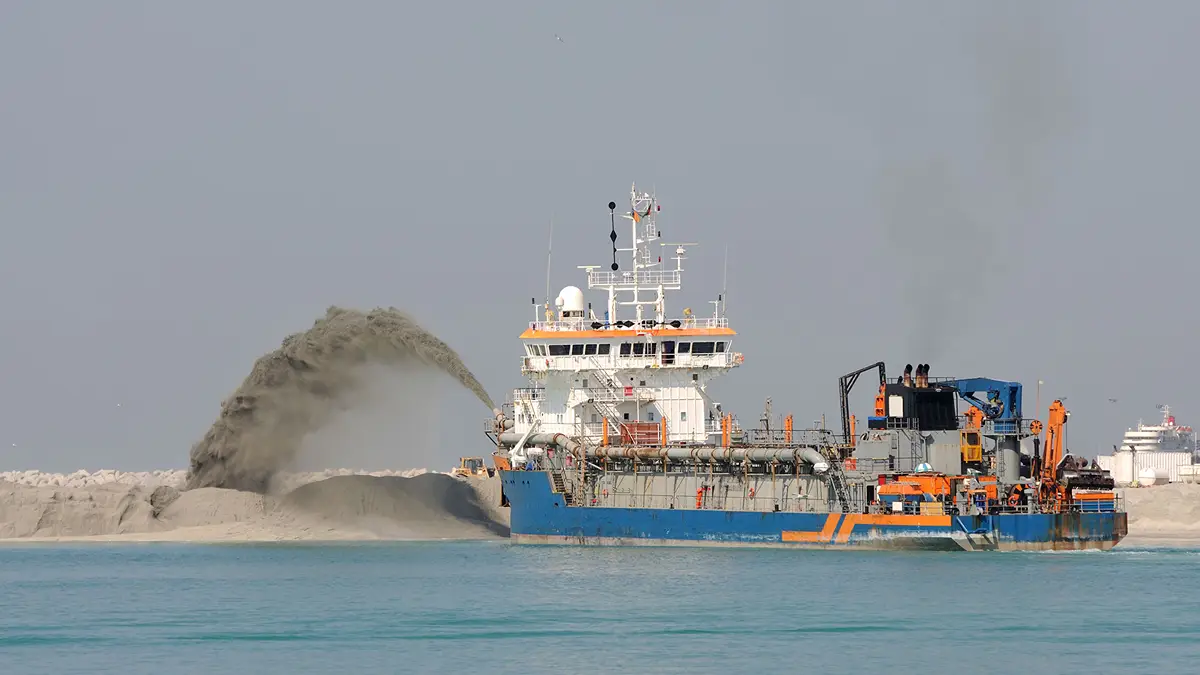
Trailing Suction Hopper Dredgers (TSHDs): These vessels “trail” a suction pipe while sailing, storing sediment in their large hoppers. They are the workhorses for open-water maintenance dredging and transporting sand for beach nourishment. Innovations like the Damen TSHD series focus on fuel efficiency and customization.
-
Cutter Suction Dredgers (CSDs): Stationary vessels that use a rotating cutter head to break up hard material (like clay or rock) before suction. They are essential for capital dredging, land reclamation, and rock excavation. The most powerful CSDs, such as those built by Jan De Nul or China’s “Tian Kun Hao,” are engineering marvels capable of creating new landmasses.
-
Backhoe Dredgers: Effectively a maritime excavator, offering precision for port berth deepening, trenching near infrastructure, and environmental remediation where control is critical.
The technological revolution is integrating Automation, AI, and Real-Time Monitoring. GPS and GIS integration now allow for centimeter-precision dredging, minimizing over-excavation and habitat disturbance. IoT sensors on pumps and engines enable predictive maintenance, reducing downtime. Furthermore, the push for sustainability is driving the development of hybrid and LNG-powered dredgers, like Van Oord’s hybrid water injection dredgers, and the use of turbidity curtains to contain sediment plumes.
Prevailing Challenges and Strategic Solutions
The industry navigates a complex matrix of technical, environmental, and economic challenges.
Environmental Compliance and Regulatory Hurdles
Dredging can disturb marine ecosystems, affecting water quality and benthic habitats. Stringent global and local regulations, such as updates to the U.S. Clean Water Act, govern the disposal of dredged material (particularly if contaminated) and set strict limits on turbidity. The solution lies in “smart dredging”—using technology to minimize impact—and beneficial reuse of sediments. Sediments are increasingly seen as a resource for wetland restoration, construction materials, or beach nourishment, aligning with circular economy principles.
High Capital and Operational Costs
The capital expenditure for a single advanced dredger can exceed $100 million. Coupled with volatile fuel prices and the high cost of skilled crews, this creates significant barriers to entry. Companies mitigate this through fleet modernization programs that prioritize fuel efficiency and versatility, and by forming consortia or public-private partnerships (PPPs) to share the financial risk of massive infrastructure projects.
Geopolitical and Logistical Complexities
Large international projects often intersect with geopolitical interests, local community concerns, and complex supply chains. Successful companies invest heavily in local stakeholder engagement, comply with local content rules, and deploy robust project management frameworks to navigate these non-technical risks.
Future Outlook: Trends Shaping the Next Decade
The future of dredging will be defined by adaptation to global megatrends.
-
Climate Resilience Infrastructure: Demand for dredging services for coastal protection, river flood management, and wetland restoration will skyrocket. Projects like the “Sand Motor” in the Netherlands, a massive coastal nourishment project designed to work with natural currents, will become more common.
-
Energy Transition Enabler: The boom in offshore wind is a major growth driver. Dredging is required for turbine foundation pits, cable trenching, and port upgrades to handle wind farm components. This sector demands specialized vessels and creates a new, stable revenue stream for the industry.
-
Digital Transformation and Autonomy: The integration of AI for route optimization, digital twins for project simulation, and the gradual development of autonomous dredging vessels will improve efficiency, safety, and precision. The christening of Van Oord’s autonomous survey vessel, “VO:X Barentsz,” points toward this future.
-
Focus on Sustainable and Adaptive Methods: Regulations will continue to tighten, favoring companies that pioneer low-impact techniques like hydrodynamic dredging, which uses natural currents to move sediment. The industry’s social license to operate will depend on its ability to demonstrate environmental stewardship transparently.
Frequently Asked Questions (FAQ)
1. Who are the “Big Four” in global dredging?
The traditional “Big Four” European leaders are Royal Boskalis (Netherlands), DEME (Belgium), Jan De Nul (Belgium), and Van Oord (Netherlands). However, Chinese giants like CCCC Dredging now command a comparable scale in terms of fleet size and project volume.
2. What is the difference between capital and maintenance dredging?
Capital dredging is the initial excavation to create new waterways, ports, or land. It’s a large, one-time project. Maintenance dredging is the recurring removal of accumulated sediment to keep existing channels and harbors at their designed depth. Maintenance dredging constitutes a significant, steady portion of the market.
3. How is dredging related to combating climate change?
Dredging is a double-edged sword. It consumes fossil fuels, but it is also a critical tool for climate adaptation. It provides the material for building sea walls and nourished beaches that protect coastal cities, and it is essential for developing the offshore renewable energy infrastructure needed to reduce global carbon emissions.
4. What are the biggest environmental concerns with dredging?
Primary concerns include: Increased turbidity (suspended sediments blocking sunlight), habitat destruction for bottom-dwelling organisms, potential release of trapped contaminants from sediments, and disruption to aquatic life from noise and activity.
5. Can dredged material be useful?
Absolutely. Beneficial reuse is a major industry trend. Clean dredged sand is perfect for beach nourishment and construction. Sediments can also be used to restore eroded wetlands, create wildlife habitats, or as engineered fill for development projects.
6. What qualifications are needed to work in the dredging industry?
It requires a mix of maritime, engineering, and environmental skills. Roles include Naval Architects, Marine Engineers, Dredge Masters, Project Managers, Hydrographic Surveyors, and Environmental Specialists. Training often involves maritime academies and extensive on-the-job experience.
7. Which regions have the highest growth potential for dredging?
Asia-Pacific remains the largest and fastest-growing market, driven by port expansions in India (Sagarmala project), China, and Southeast Asia. North America has significant ongoing demand for coastal protection, while the Middle East continues its ambitious coastal development plans.
Conclusion and Key Takeaways
The global dredging industry is a vital, dynamic, and technologically advanced sector that literally shapes the world. From the European pioneers mastering complex marine engineering to the Asian champions delivering unprecedented scale, each leading nation brings distinct capabilities to the table. Their powerful, specialized fleets—from hopper dredgers to cutter suction dredgers—are the tools that build our future infrastructure.
The industry’s trajectory is clear: success will belong to those who best integrate digital innovation, commit to environmental sustainability, and adapt to serve the dual imperatives of global trade and climate resilience. As the demand for smarter ports, cleaner energy, and safer coasts grows, the strategic importance of these underwater earthmovers will only continue to rise, ensuring their role as indispensable partners in navigating the challenges of the 21st century.
References
-
Future Market Insights. (2026-2036). Dredging Market Forecast and Outlook. Retrieved from Future Market Insights.
-
ResearchAndMarkets.com. (2025). Dredging Market Report 2025 [Press release]. Yahoo Finance.
-
EZ Connect Floats. (2025). Advancements in Dredging Technology: GPS & Automation.
-
Cognitive Market Research. (2026). Dredging Market Analysis 2026.
-
Grand View Research. (2024-2030). Dredging Equipment Market Size And Share Report.
-
The Environmental Blog. (2025, June). How Dredging Technologies Are Transforming Environmental Remediation Across Canada.
-
Haven Dredging. (2025, April 2). Adaptable dredging for a market facing regulatory changes