
Choosing the right ship management company defines your maritime career. This 2026 guide for seafarers covers how to evaluate firms on safety, training, welfare, career growth, and green shipping practices to find your best fit.
For a seafarer, the choice of a ship management company is far more than just selecting an employer; it is choosing a partner for your career at sea. This decision influences your daily life onboard, your professional growth, your safety, and your long-term future in an industry undergoing profound change. In 2026, with the maritime sector accelerating its journey toward decarbonization and digitalization, the role of a ship manager has evolved from an operational service provider to a strategic navigator of new technologies, fuels, and regulations. This guide is designed to empower you, the seafarer, with a clear framework for making this critical career decision. We will move beyond basic job listings to explore how to assess a company’s culture, its commitment to crew welfare, its investment in your skills, and its preparedness for the future of shipping. Your career deserves a manager that doesn’t just employ you but invests in you and sails alongside you through the challenges and opportunities of modern seafaring.
Why Your Choice of Ship Management Company Matters More Than Ever
In today’s complex maritime landscape, the ship management company you work for acts as the crucial intermediary between vessel owners, regulators, and your life at sea. This choice directly impacts your most fundamental professional concerns: the safety of your workplace, the fairness of your compensation, the quality of your training, and the balance between your career and personal life. A 2025 industry survey highlighted that 72% of seafarers cited a poor work-life balance as a top concern, while broader industry retention rates have been challenging. These statistics underscore that where you choose to work is a decisive factor in your career satisfaction and longevity.
Furthermore, the industry’s transformation is reshaping job requirements. The push for decarbonization, driven by International Maritime Organization (IMO) targets and regulations like the EU’s Emissions Trading System (EU ETS), means vessels are adopting new technologies and alternative fuels like methanol and ammonia. Simultaneously, digitalization is introducing AI-driven navigation, predictive maintenance, and advanced data analytics onto the bridge and in the engine room. A forward-thinking management company doesn’t just react to these changes; it proactively prepares its crew, offering specialized seafarer training and clear pathways to gain expertise in these high-demand areas. Therefore, your choice is not just about your next contract; it’s about aligning with a company that will equip you with the skills and experience to remain relevant and advance in the maritime industry of tomorrow.
Key Criteria for Evaluating a Ship Management Company
Choosing the right employer requires a structured evaluation. Look beyond the basic salary figure and consider the following interconnected pillars that define a quality ship management operation. A strong company will demonstrate excellence across all these areas, creating a supportive and professional environment.
Safety Culture and Operational Standards
A genuine safety culture is the non-negotiable foundation of a reputable ship management company. It must be evident in every policy and action. Investigate the company’s safety record, including its Port State Control detention rates and Lost Time Injury (LTI) frequency. More importantly, seek to understand the culture behind the statistics. Does the company encourage transparent reporting of near-misses without fear of blame? Are safety management systems actively used and championed by senior officers onboard? Leading firms often undergo voluntary certifications like ISO 9001 (Quality) and ISO 14001 (Environmental Management), which signal a commitment to systematic, high-standard operations beyond minimum legal requirements. In an era of increasing maritime cybersecurity threats, a robust safety culture also extends to digital security. Companies adhering to the IMO’s cybersecurity guidelines and integrating robust IT/OT (Operational Technology) protections show they are safeguarding both the vessel’s systems and the data that affects your work.
Seafarer Welfare and Life Onboard
Your well-being during long contracts is paramount. Progressive companies have moved past viewing welfare as merely providing internet access. Comprehensive programs now include structured mental health support, such as 24/7 telehealth services and confidential counseling, recognizing the unique pressures of life at sea. Evaluate the company’s policies on work-rest hour compliance, shore leave facilitation, and the quality of onboard food and accommodation. Also, consider their family support initiatives, such as communication allowances or family visitation programs, which acknowledge the importance of connections to home. The goal is to find a manager that treats you as a professional and a person, investing in initiatives that promote physical and mental health, which in turn leads to a more focused, happier, and more stable crew.
Training, Development, and Career Pathways
A company that invests in your growth is investing in its own future. Examine the breadth and modernity of its seafarer training programs. Do they offer routine STCW refreshers, or do they go further? Leading managers provide specialized, future-focused training in areas like handling alternative fuels (e.g., methanol, LNG), operating new energy-efficient technologies, using advanced diagnostic software, and understanding cyber hygiene protocols. Furthermore, inquire about clear career pathways. Does the company have a structured cadet program with mentorship? Are there documented processes for promotion from junior to senior officer ranks? Some top employers even offer “career customization” tracks, allowing experienced seafarers to transition towards shore-based management roles, ensuring your maritime knowledge remains valued throughout your working life. This commitment to continuous learning is a critical indicator of a company that views its crew as a long-term asset.
Compensation, Benefits, and Contract Clarity
Fair and transparent remuneration is essential. While salary is a key component, a holistic view is necessary. Compare the offered package against industry benchmarks like the International Transport Workers’ Federation (ITF) agreements or the International Chamber of Shipping (ICS) wage guidelines. Scrutinize the details: Are overtime calculations clear and reliably paid? What are the policies for hardship pay in high-risk areas or bonus structures for hitting safety or efficiency targets? Look for comprehensive benefits such as health insurance, retirement plans, and performance-linked bonuses. The contract itself should be clear, fair, and should explicitly outline rotation schedules, repatriation terms, and grievance resolution procedures. Transparency in financial matters is a strong indicator of overall professionalism and respect for employees.
Technological Advancement and Future Readiness
The maritime industry’s future is digital and green. The ship management company you join should have a visible strategy for this transition. Do they utilize integrated data platforms for predictive maintenance, reducing unexpected breakdowns and administrative burdens? Are they investing in or operating vessels ready for alternative fuels, and do they have the training infrastructure to support them? A company at the forefront of technology not only offers a more modern and efficient working environment but also ensures that the skills you develop onboard are relevant and valuable. Working with advanced systems prepares you for the next generation of vessels and makes you a more competitive professional in the global job market.
Analyzing Leading Ship Management Companies: A Seafarer’s Perspective
To translate these criteria into practical insights, let’s examine how some of the world’s leading ship management companies are perceived and what they offer from a seafarer’s viewpoint. The following analysis synthesizes reported strengths and initiatives that align with the key evaluation pillars.
V.Group and Anglo-Eastern: The Global Full-Service Leaders
As two of the largest independent ship managers, both set high benchmarks. V.Group is frequently noted for its scale, managing around 3,000 vessels, and its emphasis on digital integration through platforms like ShipSure. For seafarers, this can translate to streamlined processes and tech-forward operations. They have also been recognized for implementing structured wellness programs, including mandated rest periods monitored via digital tools. Anglo-Eastern, managing over 740 ships, is renowned for its massive global training footprint, including major academies in India and the Philippines. This reflects a deep institutional commitment to crew development. Reports also highlight their investment in seafarer family support and career transition programs, offering paths to shore-based management roles.
Synergy Marine Group and Columbia Shipmanagement: The Specialized Partners
These firms are often praised for a strong partnership approach with owners and a focus on specific vessel segments. Synergy Marine Group, managing a diverse fleet of around 700 vessels including complex LNG carriers and large container ships, emphasizes tailored solutions. For crews, this can mean working on well-maintained, high-specification assets. They have gained attention for offering flexible contract rotations and innovative welfare initiatives, such as onboard entertainment and fitness stipends. Columbia Shipmanagement, with over 450 ships under management, has built a strong reputation in the tanker sector, which demands rigorous safety and operational protocols. This specialization often correlates with high procedural standards and technical excellence onboard.
Wilhelmsen Ship Management and Bernhard Schulte Shipmanagement (BSM): The Established Giants
With long maritime heritages, these companies combine tradition with modern practice. Wilhelmsen Ship Management, part of a 160-year-old group, is a top third-party manager with a fleet of over 450 vessels, particularly strong in specialized segments like LNG and offshore. They are frequently cited as pioneers in seafarer mental health, having launched dedicated telehealth apps and counseling services, directly addressing a critical welfare need. Bernhard Schulte Shipmanagement (BSM), with a network of global maritime training centres, manages a fleet of about 680 ships. Their focus on transparency through digital tools for crew and a stated commitment to sustainability indicates a structured, forward-looking operational philosophy.
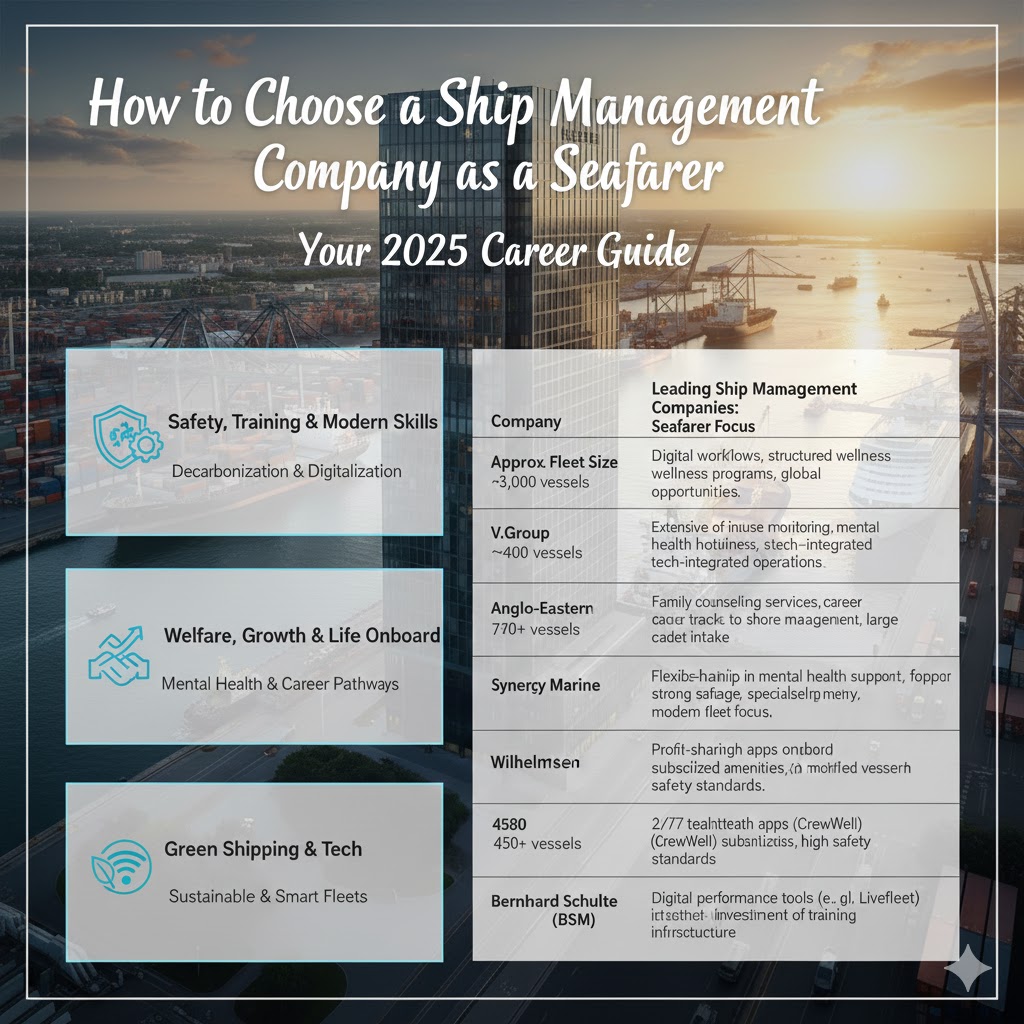
The table below provides a comparative snapshot of these industry leaders based on available data and reported seafarer insights.
| Company | Approx. Fleet Size | Reported Strengths for Seafarers | Notable Initiatives |
|---|---|---|---|
| V.Group | ~3,000 vessels | Digital workflows, structured wellness programs, global opportunities. | Mandated rest monitoring, mental health hotlines, tech-integrated operations. |
| Anglo-Eastern | 740+ vessels | Extensive in-house training academies, clear career pathways, strong shore support. | Family counseling services, career tracks to shore management, large cadet intake. |
| Synergy Marine | ~700 vessels | Flexible contract options, focus on crew morale, partnership culture. | Profit-sharing schemes, onboard welfare amenities, modern fleet focus. |
| Wilhelmsen | 450+ vessels | Leadership in mental health support, strong safety heritage, specialized vessel expertise. | 24/7 telehealth apps (CrewWell), subsidized advanced training, high safety standards. |
| Bernhard Schulte (BSM) | ~680 vessels | Global training network, operational transparency, sustainability focus. | Digital performance tools (e.g., Livefleet), investment in training infrastructure. |
Practical Steps for Your Research and Decision
Turning these criteria into action requires proactive research. Start by consulting authoritative industry resources. Platforms like the International Transport Workers’ Federation (ITF) and seafarer unions publish approved agreement lists and can provide context on fair working conditions. Use professional social networks like LinkedIn to connect with current or former employees of your target companies. Ask specific questions about culture, training opportunities, and shore support.
When preparing for an interview, flip the dynamic: come with questions for your potential employer. Inquire about their specific training programs for decarbonization technologies, their average officer retention rate, or how they handled crew changes during recent global disruptions. Ask for a tour of their training facility or to speak with a serving senior officer. The company’s willingness and ability to answer these questions transparently will be very revealing. Finally, trust your instincts during interactions. Do the recruiters and superintendents treat you with professionalism and respect? The ethos of the office often reflects the culture you will find at sea.
Future Outlook: Aligning Your Career with Industry Trends
Your career will be shaped by the same macro-trends transforming shipping. Choosing a company that is actively engaging with these trends is an investment in your own future employability. Decarbonization is not just a regulatory issue; it’s creating new specializations. Companies leading in retrofitting energy-saving devices or operating dual-fuel methanol vessels will need and train seafarers with these competencies. Similarly, digitalization and maritime AI are moving from pilot projects to core operations, with AI used for voyage optimization and predictive machinery health monitoring. Being part of a company that embraces these tools will keep your skills sharp and modern.
Furthermore, the industry’s focus on Environmental, Social, and Governance (ESG) criteria is elevating the importance of transparent sustainability reporting and ethical practices. Companies with strong ESG profiles are increasingly preferred by clients and financiers, leading to more stable business and, by extension, more secure employment. By aligning with a manager that is not just complying with but leading in these areas, you position yourself at the forefront of the profession, ready for the challenges and rewards of 21st-century shipping.
Frequently Asked Questions (FAQ)
1. As a newly graduated cadet, what should I prioritize when choosing my first ship management company?
For cadets, the quality and structure of the training program should be the top priority. Look for companies with a proven cadet deployment plan, dedicated mentors (often called sea-daddies), and a strong shore-based support team. A company’s investment in its cadet scheme is a direct indicator of how much it values long-term talent development. The size of the fleet can also be beneficial, as it may offer more varied sailing opportunities to complete your training.
2. How can I verify a company’s claims about safety culture and welfare programs?
Do not rely solely on company brochures. Check their safety performance records on public Port State Control (PSC) databases like the Tokyo or Paris MoU websites. Read the company’s Safety Management System (SMS) summary if available. For welfare, seek out anonymous reviews on seafarer forums and social media groups. Directly ask the company for contact information of a currently serving seafarer you can speak with—a reputable firm will often facilitate this.
3. I have experience with traditional fuels. How important is it to join a company investing in alternative fuels?
Extremely important for your mid-to-long-term career prospects. The transition to methanol, ammonia, LNG, and other fuels is accelerating due to IMO regulations. Companies at the forefront of this transition will provide the necessary seafarer training and hands-on experience that will make you highly valuable. Starting this upskilling journey now, even on dual-fuel capable vessels, future-proofs your career against rapid technological change.
4. What are the potential red flags during the recruitment process?
Major red flags include vague or evasive answers to direct questions about contracts, pay, or rotations; pressure to sign contracts quickly without time for review; lack of transparency about which specific vessel or fleet you will be assigned to; and any suggestion of bypassing standard safety or certification procedures. A professional company operates with clarity and patience.
5. How do I assess the work-life balance offered by a company before signing a contract?
Scrutinize the proposed rotation schedule (e.g., 4 months on/3 months off). Ask about the company’s policy on shore leave, internet connectivity speed and cost, and their track record for timely crew changes. Inquire about the average working hours per day on their vessels and how rest hours are monitored and protected. Speaking to current crew members is the most reliable way to get honest feedback on daily life.
Conclusion
Choosing the right ship management company is one of the most significant decisions in a seafarer’s career. It is a choice that weighs immediate factors like salary and contract terms against deeper elements of culture, safety, growth, and future vision. By methodically evaluating companies against the pillars of safety culture, seafarer welfare, training investment, fair compensation, and technological readiness, you move from being a passive applicant to an empowered decision-maker. The goal is to find a partnership where your skills are honed, your well-being is prioritized, and your career is navigated with foresight. In the dynamic seascape of 2025 and beyond, your chosen manager should be more than an employer; it should be the vessel that carries you confidently toward your professional horizons. Set your criteria, conduct your due diligence, and choose a company worthy of the expertise and dedication you bring on board.
References
-
360iResearch. (2025). *Ship Management Service Market – Global Forecast 2025-2032*. Retrieved December 29, 2025, from https://www.360iresearch.com/library/intelligence/ship-management-service[citation:4]
-
BCG. (2025). The Energy-Efficient Route to Maritime Decarbonization. Retrieved December 29, 2025, from https://www.bcg.com/publications/2025/energy-efficient-route-maritime-decarbonization[citation:5]
-
Bisht, D. (2025, August 20). Key Global Maritime Trends Shaping the Shipping Industry in 2025. Shipfinex. Retrieved December 29, 2025, from https://www.shipfinex.com/blog/global-maritime-trends[citation:2]
-
Crowley. (n.d.). Global Ship Management. Retrieved December 29, 2025, from https://www.crowley.com/shipping/management/[citation:6]
-
Marine Insight. (n.d.). Top 10 Ship Management Companies. Retrieved December 29, 2025, from https://www.marineinsight.com/know-more/top-10-ship-management-companies/[citation:3]
-
Market Mind Partners. (2025, September 10). Ship Management Market Size, Share, Trend [2025 To 2032]. Retrieved December 29, 2025, from https://marketmindpartners.com/ship-management-market[citation:7]
-
Sailor Speaks. (2024, September 6). Top Shipping Companies for Seafarers in 2025. Retrieved December 29, 2025, from https://sailorspeaks.com/2024/09/06/the-best-shipping-companies-for-seafarers-in-2024/[citation:10]
-
Ship Management International. (2025). *Review 2025 / Preview 2026 (Part 2, companies F to L)*. Retrieved December 29, 2025, from https://www.shipmanagementinternational.com/news/wczxsw6pcpa4yfc-3w52x-42l4p-npkey-pxams-hrpfr-d7676-3f42z-5tzsk-jld8s-l3ene-jtt23-7eesc-5hakp-w4m6e-hrh2t[citation:9]
-
Spherical Insights. (2025, August). Top 40 Global Vessel Traffic Management Companies (2025–2035): Spherical Insights Analysis. Retrieved December 29, 2025, from https://www.sphericalinsights.com/blogs/top-40-global-vessel-traffic-management-companies-2025-2035-spherical-insights-analysis[citation:1]
-
Thomas Schulte Ship Management. (n.d.). Thomas Schulte Ship Management. Retrieved December 29, 2025, from https://www.tsm-shipmanagement.com/[citation:8]