

The Horn’s Achilles’ Heel and the World’s Artery
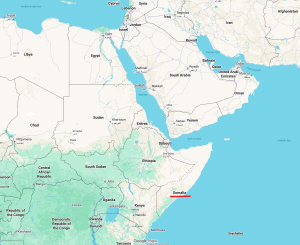
Nestled on the easternmost projection of Africa, Somalia commands one of the most strategically consequential coastlines on Earth. Stretching over 3,300 kilometers—the longest in mainland Africa—it guards the southern flank of the Gulf of Aden and forms the entirety of the western shoreline of the Indian Ocean approach to the Bab el-Mandeb Strait. This narrow maritime chokepoint, the “Gate of Tears,” is the critical funnel connecting the Indian Ocean to the Red Sea and, via the Suez Canal, to the Mediterranean and Europe. Through this corridor flows approximately 12% of global seaborne trade, including 30% of the world’s containerized cargo and a staggering portion of hydrocarbon exports from the Persian Gulf to Europe and North America. Every day, millions of barrels of oil, liquefied natural gas (LNG), and countless containers of manufactured goods navigate these waters, making their safe passage a non-negotiable imperative for the global economy.
Somalia’s importance, however, is a tale of tragic paradox. Its geographic endowment is a gift of immense strategic value, yet its modern history has been one of profound state weakness, conflict, and fragmentation. For decades, the country has been synonymous with state collapse, terrorism, and piracy. This juxtaposition—between critical location and chronic instability—defines the geopolitics of Somalia and its coastline. The central question for global maritime security and trade is not merely about recognizing Somalia’s importance, but understanding the terrifying consequences if the current fragile state structure dissolves into renewed, large-scale conflict or definitive partition. The collapse or division of Somalia would not be a localized African tragedy; it would trigger a seismic shock through the world’s most vital maritime arteries, inviting external intervention, exacerbating regional rivalries, and creating a permanent zone of danger at the heart of global logistics.
I. The Foundations of Somalia’s Maritime Geostrategic Value
A. Geography as Destiny: Chokepoints and Sea Lanes
Somalia’s irreplaceable value stems from immutable geography. The Horn of Africa acts as a massive natural pier jutting into the Indian Ocean, dominating the approach to the Bab el-Mandeb. The country’s territorial waters and Exclusive Economic Zone (EEZ) span over 1.2 million square kilometers, rich in fish stocks and potential hydrocarbons. Control—or the lack thereof—over this coastline directly impacts the security of the Sea Lanes of Communication (SLOCs) that are the circulatory system of global commerce. Any threat emanating from the Somali coast can immediately disrupt traffic entering or exiting the Red Sea, with cascading effects on shipping schedules, insurance costs, and energy prices worldwide.
B. The Historical Context: From Ancient Trade to Cold War Pawn
Somalia’s maritime significance is not new. For centuries, its ports—such as Mogadishu (the ancient “City of Islam”), Berbera, and Kismayo—were hubs of Indian Ocean trade, connecting the African interior with Arabia, Persia, India, and beyond. The colonial division of the Horn between Britain, Italy, and France fragmented Somali-inhabited territories but underscored the coast’s strategic value. During the Cold War, Somalia’s location made it a prized client state, with the Soviet Union (and later the United States) gaining access to naval facilities at Berbera, seeking to control the oil routes and monitor rival naval movements.
C. The Somali State: From Collapse to Fragile Reconstitution
The collapse of the Siad Barre regime in 1991 plunged Somalia into anarchy, creating the world’s most famous failed state. For over two decades, there was no central government to control the coastline, a vacuum that gave birth to the infamous Somali piracy phenomenon (2005-2012). This episode was a stark, costly demonstration of how instability in Somalia directly threatens global shipping. The internationally-backed Federal Government of Somalia (FGS), established in 2012, remains weak, contested by the jihadist insurgency of Al-Shabaab, and locked in complex disputes with emerging Federal Member States (FMS) like Puntland, Jubaland, and Somaliland (which declares independence). This fragile, contested sovereignty is the precarious lid on a geostrategic pressure cooker.
II. The Modern Geopolitical Chessboard: External Powers and Their Interests
Somalia’s instability occurs in a theater crowded with competing regional and global powers, each with vital stakes in the maritime domain.
A. Regional Rivalries: The Gulf in the Horn
The most intense competition plays out between Gulf powers, for whom the Bab el-Mandeb is an existential priority.
-
Turkey: Has emerged as the most invested foreign actor in the FGS, operating Mogadishu’s port and airport, providing extensive humanitarian and military aid, and establishing its largest overseas military base in the capital. Turkey sees Somalia as a cornerstone of its strategic depth doctrine and a platform for influence in Africa and the Indian Ocean.
-
The United Arab Emirates (UAE): Pursues a different strategy, backing sub-national entities to secure port access and political influence. The UAE has developed the ports of Berbera (in Somaliland) and Bosaso (in Puntland) and maintains a military base in Berbera. It views the Muslim Brotherhood-aligned FGS (and thus Turkey) as a threat and prefers dealing with more pliant local authorities.
-
Qatar & Saudi Arabia: Have been involved in the rivalry, generally aligning with Turkey and the UAE, respectively, further entangling Somali politics in Gulf disputes.
-
Egypt: Considers the Nile’s water security its paramount interest. It views Ethiopian dams with extreme anxiety and sees secure passage through the Bab el-Mandeb—potentially threatened by an adversarial power controlling the Somali coast—as crucial. Egypt has historically supported the FGS to counter any Turkish or Islamist dominance that could threaten the strait.
B. Global Powers: Counter-Terrorism and Great Power Competition
-
United States: Focuses primarily on counter-terrorism against Al-Shabaab (linked to Al-Qaeda), conducting drone strikes and maintaining a small military presence. Its secondary interest is containing Chinese influence and ensuring freedom of navigation. The U.S. leads multinational naval task forces (like Combined Task Force 151) dedicated to combating piracy and maritime terrorism in the region.
-
China: Has significant economic interests tied to the SLOCs, being the largest importer of Gulf oil and a global trading giant. While politically supportive of the FGS, China’s primary regional footprint is in Djibouti, where it established its first overseas military base in 2017, explicitly to protect its shipping and support anti-piracy missions. A destabilized Somalia represents a direct risk to China’s Belt and Road Initiative (BRI) maritime corridors.
-
European Union: Heavily dependent on the Suez route for trade with Asia. The EU launched and funded the EU Naval Force (EUNAVFOR) Operation Atalanta, a pivotal military response to Somali piracy. European security is directly tied to stability on the Somali coast.
-
Regional African Actors: The African Union Transition Mission in Somalia (ATMIS), a peacekeeping force, has been critical in propping up the FGS. Ethiopia, a landlocked regional hegemon, desperately needs access to ports and views a friendly, united Somalia as preferable to a fragmented one that could harbor threats. Kenya, suffering from Al-Shabaab attacks, has troops in ATMIS and is deeply concerned about spillover instability.
III. The Sword of Damocles: Consequences of State Collapse or Division
The current situation is precarious but managed. A full collapse of the FGS or a formal, violent partition of Somalia would shatter this uneasy equilibrium, with catastrophic and multifaceted consequences.
A. For Global Maritime Transport and Shipping: A Perfect Storm
-
The Return of Piracy 2.0: The defeat of piracy required a combination of robust naval patrols, hardened ship security, and—critically—the establishment of onshore governance in pirate havens like Puntland. A national collapse would erase that onshore component. Rival militias and desperate communities would have every incentive to resume hijacking, likely with more sophisticated tactics learned over a decade. Insurance premiums for the Gulf of Aden would skyrocket overnight, and shipping companies might reroute traffic around the Cape of Good Hope, adding 10-14 days and immense cost to Asia-Europe trade.
-
Maritime Terrorism: Al-Shabaab, or new jihadist franchises, could gain unchallenged control of port cities and coastline stretches. This would enable them to launch direct maritime attacks (suicide boat bombings, mining harbors, targeting naval vessels) far more ambitious than their previous land-based terrorism. The threat to commercial shipping would become existential, not just criminal.
-
Strategic Chokepoint Instability: With no recognized authority to negotiate with or police, the western shore of the Bab el-Mandeb would become a lawless bastion for threats. Naval task forces would be forced into perpetual defensive patrolling, and any incident could lead to a complete, temporary closure of the strait—an event that would send shockwaves through global energy and stock markets.
-
Disruption of Critical Ports: The managed ports of Mogadishu (Turkey), Berbera (UAE/DP World), and Bosaso (UAE) would become flashpoints. Competing militias or terrorist groups would fight for control of these revenue-generating assets. Their operations would cease, disrupting not only Somali imports (including vital food aid) but also the logistics networks external powers have built.
B. For Regional and Global Geopolitics: A Scramble for the Coast
-
Proxy War Escalation: A collapsed Somalia would become the ultimate proxy battleground. Turkey, the UAE, Egypt, Qatar, and others would be forced to double down on their local allies, directly supplying and perhaps militarily supporting them to control strategic coastline assets. This would transform Somali civil conflict into a direct confrontation of regional powers.
-
Humanitarian and Migration Crisis: Famine and violence would trigger a massive exodus by sea. The Yemen model—where a war-torn coast leads to desperate migrant flows—would be replicated on a larger scale, challenging naval resources and creating human tragedies in the busy shipping lanes.
-
Redrawing of Maps and Precedents: The most likely division would be the formal secession of Somaliland. While relatively stable, its recognition would shatter the African Union’s sacrosanct principle of uti possidetis (inviolability of colonial borders), potentially inspiring secessionist movements across the continent. It could also trigger a violent contest for the remaining Somali regions, as Puntland, Jubaland, and others might seek greater autonomy or alignment with foreign patrons.
-
Great Power Confrontation: The U.S., China, and European powers would face impossible choices. Would they intervene unilaterally to secure chokepoints? Would they recognize breakaway states to deal with functional entities? Would they attempt a new, massive international stabilization mission? Their competing interests could lead to friction, as seen in Libya or Syria, but in a far more strategically sensitive location.
IV. Pathways Forward: Mitigation, Containment, and the Imperative of Stability
Avoiding this doomsday scenario requires a clear-eyed, multi-pronged strategy that acknowledges both Somalia’s sovereignty and the global stakes.
-
Prioritizing Maritime Security & Economic Development: International efforts must go beyond counter-terrorism to build Somalia’s own maritime security capacity. This means sustained investment in the Somali Coast Guard, judiciary for maritime crimes, and development of the legitimate blue economy (fisheries, port revenue). Giving Somalis a sustainable stake in their coastline’s legal use is the only durable antidote to piracy and crime.
-
De-escalating External Rivalries: The international community, perhaps through the UN or a contact group, must pressure Gulf and other rivals to establish “rules of engagement” in Somalia, preventing a zero-sum competition that fuels internal fragmentation. A regional consensus on respecting Somali sovereignty is essential.
-
Supporting Inclusive Somali-led Governance: There is no military solution. The difficult, messy process of building a federal, inclusive political settlement—one that balances Mogadishu’s authority with legitimate regional aspirations—must be the paramount political objective. This is the only foundation for long-term stability.
-
Preparing for Contingencies: Naval powers must jointly plan for maritime security contingencies in the event of state failure. This includes pre-agreed protocols for protecting SLOCs, intercepting threats, and managing a humanitarian crisis at sea, to avoid confusion and conflict between external actors themselves.
Conclusion: Somalia’s Coastline—A Global Commons in Peril
Somalia is not a remote African problem. It is the guardian—albeit a wounded and struggling one—of a critical global commons. The importance of its coastline for maritime transport is absolute, woven into the fabric of globalized trade and energy security. The geopolitics surrounding it are a microcosm of 21st-century contests: regional hegemony, great power competition, and the battle against non-state threats.
The collapse or division of Somalia would unlock a Pandora’s box of horrors for shipping: a resurgence of piracy, the specter of maritime terrorism, and the transformation of the Bab el-Mandeb from a busy highway into a dangerous alley. It would ignite a regional scramble for control, drawing in outside powers and potentially rewriting the map of the Horn of Africa.
Therefore, supporting Somalia’s stability and unity is not an act of charity; it is a strategic imperative of the highest order. It requires moving beyond short-term crisis management and emergency aid towards a sustained, coherent international commitment to help Somalis build a state that can govern its own destiny—and secure the world’s most vital sea lanes. The price of failure is not just Somali; it will be paid at gas pumps, in shipping logjams, and in the darkened boardrooms of every trading nation on earth. The lesson of geography is clear: the fate of Somalia is inextricably linked to the security and prosperity of the world.