
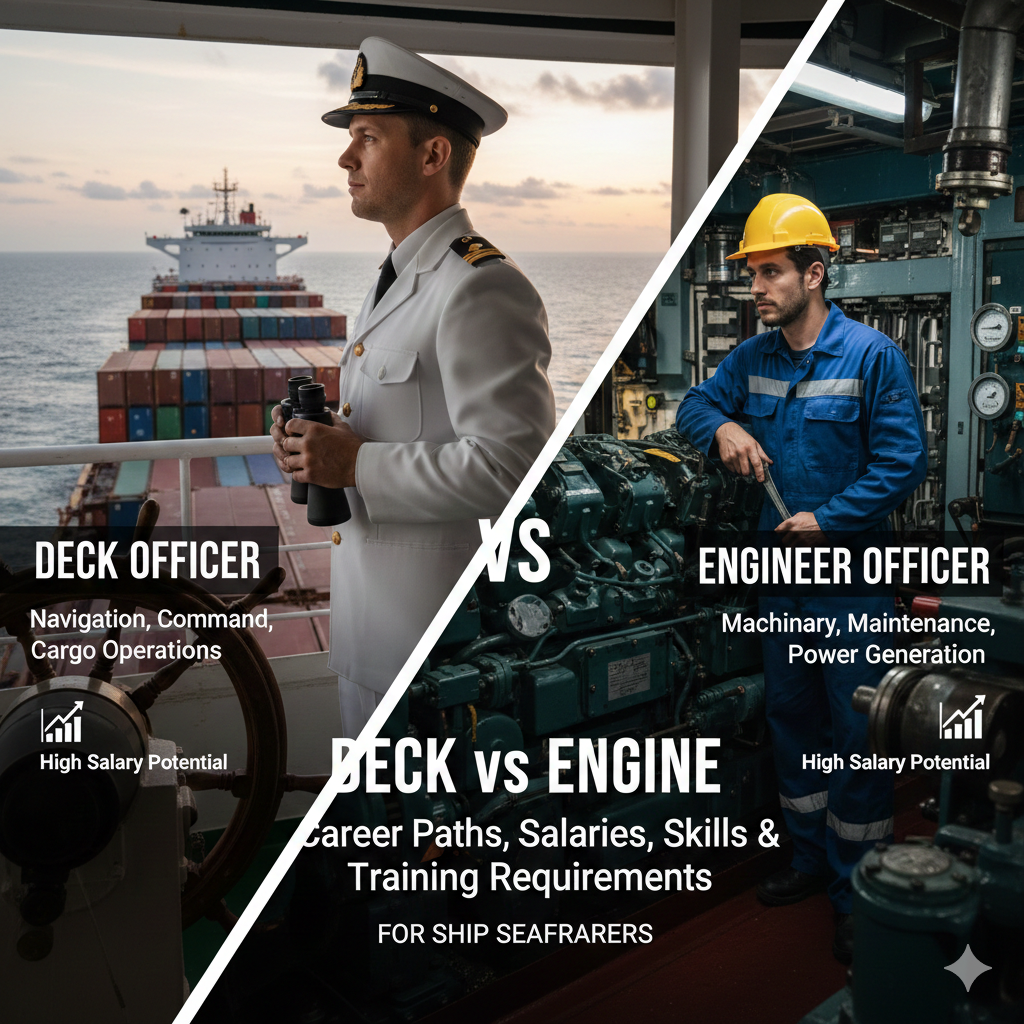
Deck vs Engine: Explore salaries, skills, training requirements, duties, and career paths for seafarers. A complete guide to choosing your maritime career.
Every young seafarer eventually faces one of the most defining decisions of their maritime career:
Should I join the Deck Department or the Engine Department?
This question goes beyond choosing a uniform or a workspace on the ship. It shapes your responsibilities, day-to-day life, salary progression, shore-based opportunities, and even your identity as a maritime professional.
For some, the bridge — quiet, bright, panoramic — represents authority and decision-making.
For others, the engine room — mechanical power, diagnostics, complex systems — feels like the heartbeat of the vessel.
Both paths offer excellent global employment, strong career progression, and structured training under the IMO STCW Convention, but the experiences differ dramatically.
Why This Topic Matters for Maritime Operations
Choosing the right department is not just a personal career decision — it affects the efficiency, safety, and compliance of ship operations worldwide.
The maritime industry is facing:
-
Crew shortages, especially among officers (ICS, BIMCO Seafarer Workforce Report 2021 and upcoming 2025 figures show persistent gaps).
-
Increasingly complex technologies, from digital navigation to smart engine automation.
-
Heightened regulatory pressure under IMO conventions (STCW, SOLAS, MARPOL).
-
A new generation of seafarers balancing expectations about salary, workload, and career mobility.
Deck and Engine departments must work in synchronization.
The ship cannot sail without navigation, and cannot move without propulsion.
Understanding both sides enables better coordination, safer operations, and informed career choices for aspiring cadets.
Key Developments, Technologies, and Principles
Navigation Revolution on Deck Side
Modern deck officers no longer rely solely on paper charts and celestial fixes (though these remain foundational skills). Over the last decade, bridge teams have adopted:
Integrated Bridge Systems (IBS)
Combining radar, ECDIS, AIS, GPS, autopilot, and alarms into a single operational center.
Authorities like DNV, ABS, and Lloyd’s Register increasingly require integrated bridge audits.
ECDIS Competency Requirements
Under STCW A-II/1, mandatory training in ECDIS changed navigation forever.
Deck officers today must master:
-
ENC interpretation
-
Route planning
-
Safety contours
-
Safety management integration
BRM / BTM (Bridge/Bridge Team Management)
Required by STCW, BRM emphasises:
-
Communication
-
Situational awareness
-
Multi-national crew coordination
Engine Room Digitalisation & Automation
While deck has become digital, the engine room has become smart.
Condition-Based Monitoring
Large shipping companies (e.g., Maersk, MSC, MOL, and many LNG operators) increasingly rely on:
-
Vibration diagnostics
-
Oil analysis
-
Thermal imaging
-
Remote sensor monitoring
Engine Control Room (ECR) Evolution
Engineers now operate:
-
PLC-controlled systems
-
Automated UMS (Unmanned Machinery Space) ships
-
Advanced alarm management
New Fuels & Technical Skills
Marine engineers must navigate the shift to:
-
LNG, LPG, methanol propulsion
-
Hybrid battery systems
-
Scrubber operations
-
NOx Tier III compliance technologies
Regulatory frameworks such as IMO MARPOL Annex VI require deeper engineering knowledge than ever before.
Deck Department: Duties, Skills, Training, Salaries, Career Path
What the Deck Department Does
The Deck Department manages:
-
Navigation
-
Cargo operations
-
Safety management
-
Mooring operations
-
Communication with VTS & pilots
-
Compliance with COLREGs, SOLAS, and MARPOL
-
Ship stability and seaworthiness
Deck officers are responsible for the safety of the vessel, crew, environment, and cargo.
Career Path on the Deck Side
-
Deck Cadet
-
Third Officer
-
Second Officer (Navigation Officer)
-
Chief Officer
-
Master (Captain)
Core Duties by Rank
Deck Cadet
Learns seamanship, bridge watchkeeping, cargo operations, and safety equipment maintenance.
Third Officer
Typically responsible for:
-
Lifesaving appliances
-
Firefighting systems
-
Bridge watch (0000–0400 or 0800–1200)
Second Officer
The navigator of the ship:
-
Passage planning
-
Chart corrections
-
ECDIS updates
-
Gyro/compass checks
Chief Officer
Cargo and stability expert:
-
Ballast management
-
Cargo loading/discharging
-
Port operations
-
Deck crew supervision
Master
Legal and operational head of the vessel:
-
Command authority
-
Safety culture
-
Ship security
-
Daily communication with company, ports, authorities
Skills Required for Deck Officers
-
Strong situational awareness
-
Decision-making under pressure
-
Maritime English & GMDSS communication
-
Proficiency with ECDIS, radar, ARPA
-
Understanding of COLREGs
-
Stability knowledge
-
Leadership and bridge-team management
-
Risk assessment & safety culture
STCW Training Requirements (Deck)
Key certificates include:
-
STCW II/1 OOW Deck
-
STCW II/2 Chief Mate/Master
-
Basic Safety Training
-
Advanced Firefighting
-
GMDSS GOC
-
BRM/BTM courses
-
ECDIS certificate
-
Medical care/first aid
Refer to IMO:
https://www.imo.org/en/OurWork/HumanElement/Pages/STCW-Convention.aspx
Deck Officer Salary Range (2024–2025)
(Figures vary by vessel type, company, area, and seniority — based on ICS, Drewry, and industry reports)
-
Deck Cadet: €400–€1,200 / month
-
Third Officer: €2,000–€4,000
-
Second Officer: €3,000–€6,000
-
Chief Officer: €6,000–€10,000
-
Master: €9,000–€18,000+
Highest salaries are typically on:
-
LNG/LPG carriers
-
Offshore vessels
-
VLCCs
-
Drillships (less common today)
Engine Department: Duties, Skills, Training, Salaries, Career Path
What the Engine Department Does
The Engine Department handles:
-
Main engine and auxiliaries
-
Generators, boilers, compressors
-
Fuel systems & purification
-
Steering gear & pumps
-
Engine control systems
-
Power management
-
HVAC and electrical systems
-
Troubleshooting & repairs
-
Pollution prevention systems
Their job is to keep the ship moving safely and efficiently.
Engine Career Path
-
Engine Cadet
-
Fourth Engineer
-
Third Engineer
-
Second Engineer
-
Chief Engineer
Core Duties by Rank
Engine Cadet
Learns maintenance routines, engine room watch, and safety procedures.
Fourth Engineer
Responsible for:
-
Purifiers
-
Air compressors
-
Sewage and freshwater systems
-
Watch duty
Third Engineer
Handles:
-
Boilers
-
Fuel systems
-
Generators
Second Engineer
Manages:
-
Daily engine room operations
-
PMS (Planned Maintenance System)
-
Spare parts and repairs
Chief Engineer
The technical head of the vessel:
-
Overall machinery responsibility
-
Legal compliance with MARPOL & SOLAS
-
Budgeting & spare parts
-
New fuel and emissions technologies
Skills Required for Marine Engineers
-
Problem-solving under pressure
-
Strong mechanical and electrical skills
-
Diagnostics and troubleshooting
-
Electronic engine controls (ME engines)
-
Leadership in technical emergencies
-
Safety & risk assessment
-
Familiarity with MARPOL Annex I, VI
-
Heavy machinery operations
STCW Training Requirements (Engine)
-
STCW III/1 OOW Engineer
-
STCW III/2 Second Engineer/Chief Engineer
-
Motor or Steam Engineer Endorsement
-
High Voltage Training (mandatory for many vessels)
-
Basic/Advanced Safety Training
-
Engine Room Resource Management (ERRM)
Refer to STCW Code via EMSA:
https://www.emsa.europa.eu/domains/training/stcw.html
Marine Engineer Salary Range (2024–2025)
-
Engine Cadet: €400–€1,200
-
Fourth Engineer: €2,000–€4,000
-
Third Engineer: €3,500–€6,000
-
Second Engineer: €6,000–€9,000
-
Chief Engineer: €9,000–€17,000+
Engineers often earn slightly more than deck officers on certain ship types due to technical responsibilities and shortage of specialist skills.
Challenges and Practical Solutions
1. Workload Differences
Deck officers may face peak workload during:
-
Approach to ports
-
Pilotage
-
Navigation in coastal waters
Engineers face peak load during:
-
Machinery failures
-
Port operations
-
Bunkering
-
Changeovers
Solution:
Improved BRM/ERM training and company-level workload monitoring.
2. Stress & Fatigue
Fatigue remains a top contributor to accidents (MAIB, USCG reports).
Solution:
Companies implementing:
-
Fatigue risk management systems
-
Digital watchkeeping records
-
UMS automation
3. Multi-National Crew Communication
Deck relies on precise communication across accents and cultures.
Engineers rely on technical vocabulary and teamwork.
Solution:
Maritime English courses under IMO Model Course 3.17.
4. New Technology Skills Gap
Both departments require new competencies:
-
ECDIS, BRM for deck
-
LNG/methanol fuels & ME engines for engineering
Solution:
Continuous professional development (CPD) and simulator-based training.
Case Studies / Real-World Applications
Case Study 1 — LNG Carrier Operations
LNG ships require:
-
Deck: strict under-keel clearance, hazardous zones, custody transfer
-
Engine: dual-fuel engines, gas compressors, reliquefaction
Both departments must coordinate intensively.
Case Study 2 — Container Ship Schedule Pressure
Deck teams handle:
-
Tight port rotations
-
Congested waterways
-
Weather routing
Engineers deal with:
-
High engine loads
-
Lubrication condition monitoring
-
Energy efficiency tasks under SEEMP
Case Study 3 — Offshore Support Vessels
Dynamic positioning (DP) requires:
-
Deck: DP operations, anchor handling
-
Engine: multiple generators, power management
A DP incident often involves both sides.
Future Outlook and Maritime Trends
1. Decarbonisation & Green Fuels
Engineers will increasingly work with:
-
LNG, LPG, methanol, ammonia
-
Batteries and hybrid systems
-
Carbon capture prototypes
Deck officers must manage:
-
Alternative bunker operations
-
Emission reporting under CII, EU ETS
2. Digital Ships
Both departments will rely on:
-
AI-assisted navigation
-
Predictive maintenance
-
Cybersecurity measures
3. Shore-Based Career Opportunities
Deck Side:
-
Pilotage
-
Vessel traffic services (VTS)
-
Superintendent
-
Port state control inspector
-
Maritime surveyor (Class/Flag)
-
Marine insurance / P&I clubs
Engine Side:
-
Technical superintendent
-
Shipyard engineer
-
Machinery surveyor
-
Marine equipment sales/service
-
Power plant operations
-
Offshore energy sector
Both paths lead to strong shore careers.
FAQ Section
1. Which is better: Deck or Engine?
Neither is “better” — it depends on your skills.
Deck: navigation, leadership, decision-making.
Engine: technical problem-solving, machinery skills.
2. Which has a higher salary?
Engineers often have slightly higher salaries, especially on technical vessels.
3. Which department is easier for cadets?
Deck is more theoretical and procedural; engineering is more hands-on and mechanical.
4. Are there better shore jobs for Deck or Engine officers?
Both have strong opportunities; engineers are in higher demand in power/energy sectors.
5. Do engine officers work in heat and noise?
Yes — though modern ECRs and PPE reduce exposure.
6. Do deck officers have less physical work?
Generally yes, but mooring, anchoring, and cargo operations can be demanding.
7. Can I switch from Deck to Engine?
Rare, but possible through full STCW retraining.
Conclusion
Choosing between the Deck and Engine departments is one of the biggest decisions a seafarer will make — shaping your training path, salary progression, lifestyle at sea, and shore career options.
If you enjoy navigation, leadership, communication, and working with advanced digital tools, the Deck Department may be the right fit.
If you prefer mechanical systems, diagnostics, machinery, and solving technical problems, the Engine Department offers a deeply rewarding path.
Both are essential pillars of global shipping and provide excellent long-term careers.
Whichever you choose, the maritime world needs motivated, skilled, and safety-conscious professionals ready to support the future of sustainable, digital, and resilient shipping.
References
-
IMO STCW Convention: https://www.imo.org/en/OurWork/HumanElement/Pages/STCW-Convention.aspx
-
EMSA Training Requirements: https://www.emsa.europa.eu
-
ICS & BIMCO Seafarer Workforce Report
-
MAIB Safety Bulletins: https://www.gov.uk/maib
-
USCG Marine Safety Center: https://www.dco.uscg.mil/msc/
-
DNV Maritime: https://www.dnv.com/maritime
-
Lloyd’s Register: https://www.lr.org
-
UNCTAD Maritime Statistics: https://unctad.org/topic/transport-and-trade-logistics/statistics