
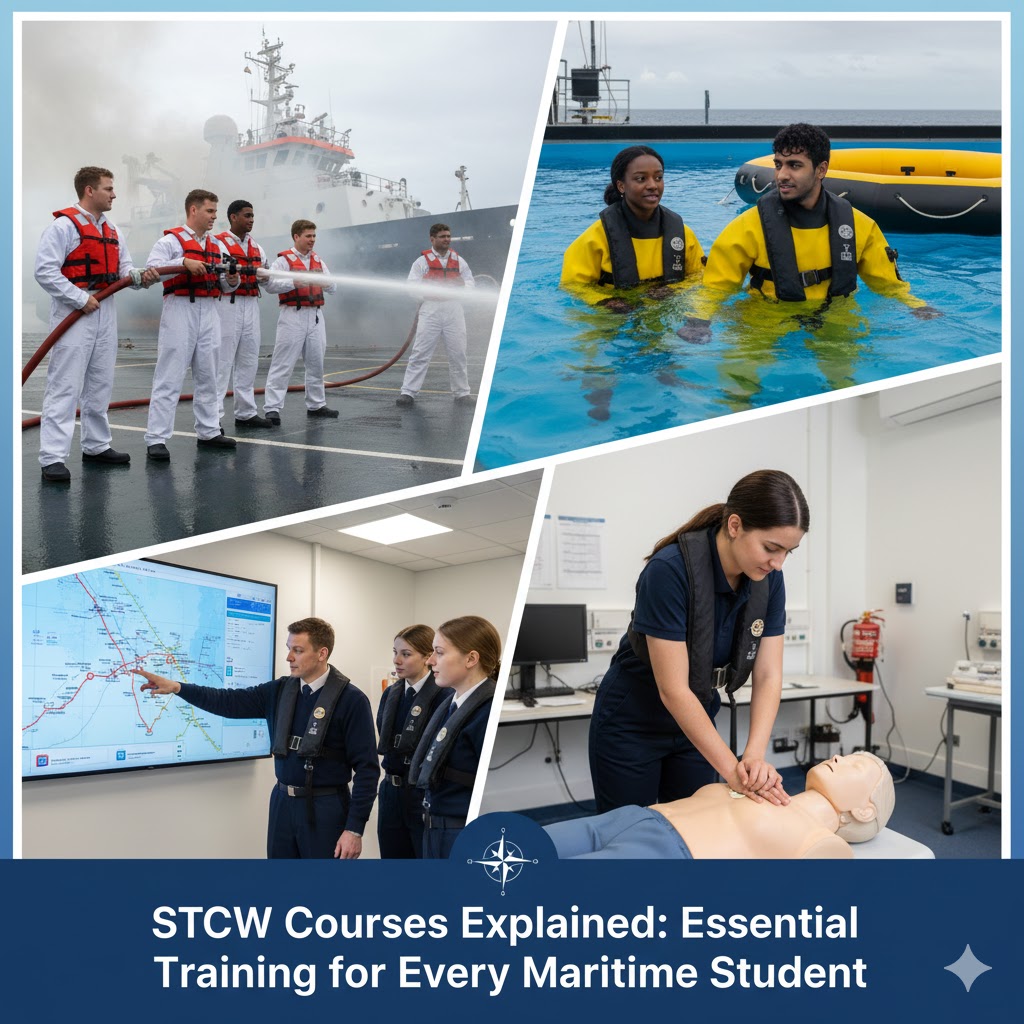
A complete guide to STCW courses for maritime students. Learn essential training, certificate requirements, safety skills, and how STCW prepares you for life at sea.
Introduction
Before a maritime student ever steps foot on a ship, they must complete one of the most foundational elements of their seafaring journey: STCW courses. These internationally recognised programs shape the safety mindset, technical skills, and emergency preparedness needed for life at sea. For many cadets, beginning their STCW training feels like the moment their dream of becoming a seafarer becomes real. The transition from classroom theory to hands-on survival training marks the first point at which they experience the discipline, teamwork, and responsibility of maritime life.
STCW courses are not simply bureaucratic requirements; they are designed to save lives, prevent disasters, protect the marine environment, and prepare seafarers for extreme conditions — from fires and flooding to medical emergencies and ship abandonments. The Standards of Training, Certification and Watchkeeping (STCW), first established by the International Maritime Organization (IMO) in 1978 and significantly updated in 1995 and 2010 (Manila Amendments), provide the global baseline for maritime training. Every officer and rating, from deck cadets to chief engineers, must pass through this framework.
This detailed article explains the essential STCW courses required for maritime students. It examines why they matter, how they are delivered, how technology is changing maritime training, and how these courses prepare students for their first contract and beyond. Whether you are an aspiring seafarer, a parent guiding your child’s maritime education, or an institution seeking to improve your MET curriculum, this article offers a comprehensive, humanised deep dive into the world of STCW.
Why This Topic Matters for Maritime Operations
The maritime sector depends on safety-critical human performance. Vessels operate in remote waters with limited external support, meaning that every individual onboard must be prepared to respond to emergencies quickly, confidently, and correctly. Casualty investigations conducted by authorities such as the MAIB, USCG, AMSA, and Transport Safety Boards repeatedly show that good training prevents accidents — and poor training magnifies risk.
STCW exists because of past disasters. Fires, collisions, cargo incidents, and pollution events have taught the global maritime community that safety cannot rely on equipment alone; it also requires skilled people. The 2010 Manila Amendments strengthened this principle by introducing new competencies, updating medical requirements, expanding security training, and improving watchkeeping standards. These changes reflected the evolving complexity of ships, from digital navigation systems to environmentally sensitive cargoes like LNG and chemicals.
For maritime operations, the importance of STCW courses goes far beyond compliance. Well-trained cadets:
-
Reduce operational risk
-
Strengthen safety culture
-
Prevent equipment misuse
-
Ensure proper communication
-
Support crisis management
-
Maintain shipboard routines
-
Contribute to environmental protection
The shipping industry is experiencing growing demand for competent officers and engineers, especially for specialised vessels such as tankers, LNG carriers, offshore units, and Ro-Ros. STCW courses lay the groundwork for cadets entering these sectors, equipping them with skills needed for safe navigation, engine operations, emergency response, and teamwork aboard modern vessels.
In short, STCW is the foundation upon which every maritime career is built.
Key Developments / Technologies / Principles in STCW Training
Modern Simulation Technology in STCW Delivery
Simulation-based learning has become one of the most transformative developments in maritime training. Many STCW courses now integrate simulator scenarios to replicate real emergencies. Full Mission Bridge Simulators allow students to practice collision avoidance, emergency manoeuvres, and distress communications, while Engine Room Simulators create realistic machinery malfunctions for engineering trainees.
Classification societies such as DNV, ABS, Lloyd’s Register, and ClassNK often assess simulator standards, and academies must meet strict technical and pedagogical criteria. These technologies help students build muscle memory and rapid decision-making skills long before joining ships.
Digitalisation and Networking in Emergency Training
Modern ships rely heavily on integrated systems — ECDIS, radar overlays, smart machinery monitoring, cyber-protected networks, and digital reporting tools. STCW training increasingly includes modules on digital communication, electronic navigation, alarm management, and cyber risk awareness. Students learn how to interpret digital alerts, avoid overreliance on automation, and maintain situational awareness even when systems fail.
Environmental and Sustainability Training
With tightening global regulations under MARPOL and the IMO GHG Strategy, STCW courses increasingly highlight pollution response, spill containment basics, energy efficiency, ballast water management, and environmentally responsible behaviour. Maritime students learn that their everyday decisions impact marine ecosystems, port operations, carbon emissions, and vessel performance.
Human Factors, Leadership, and Resource Management
Modern maritime education recognises that accidents are often caused not by technical failure but by human behaviour. Courses such as BRM (Bridge Resource Management) and ERM (Engine Room Resource Management) train cadets to communicate clearly, manage stress, share situational awareness, and apply leadership principles in high-pressure environments. These skills form the backbone of safe watchkeeping.
Security and Anti-Piracy Training
Changes in global security risks, including piracy in the Gulf of Guinea and tensions in key choke points, have increased the emphasis on security awareness. STCW now includes security training (VI/6), covering topics such as suspicious behaviour detection, access control, anti-piracy precautions, and emergency security procedures. This ensures cadets understand responsibilities under the ISPS Code.
Essential STCW Courses Explained
Below are the most crucial courses, described in narrative form rather than bullet lists, as requested.
1. Basic Safety Training (BST) — The Foundation of Maritime Life
Basic Safety Training is the first exposure maritime students have to safety culture. This course is divided into four modules: Personal Survival Techniques, Fire Prevention and Firefighting, First Aid, and Personal Safety and Social Responsibilities. Instead of learning passively through lectures, students spend significant time performing realistic drills.
Cadets wear survival suits, board life rafts, signal for rescue, and experience entering the water from height — sensations that stay with them for life. In firefighting modules, students learn to handle hoses, extinguish different fire types, navigate smoke-filled rooms, and work as a team under pressure. These experiences teach discipline, courage, and trust among peers.
The First Aid component provides practical training in CPR, bleeding control, shock treatment, and injury management. Meanwhile, PSSR introduces students to shipboard hierarchy, communication norms, multicultural teamwork, and safety responsibilities. Together, these modules form the foundation of all future STCW learning.
2. Proficiency in Survival Craft and Rescue Boats (PSCRB)
PSCRB prepares cadets for launching, operating, and managing survival craft. Students learn how to operate lifeboats, fast rescue boats, davits, and launching systems. They also practice command roles, learning how to give orders, maintain discipline, and ensure survival in extreme conditions. Many students recall this course as one of the most demanding in their training, especially during exercises in cold water or bad weather.
3. Advanced Firefighting (AFF)
Advanced Firefighting builds on the basic firefighting module but adds complexity, leadership, and tactical decision-making. Cadets learn to manage fire parties, coordinate search and rescue, interpret fire control plans, and communicate with the bridge and engine room. Modern fire simulators expose students to intense heat, poor visibility, and realistic emergency atmospheres. This course is essential for students aiming for officer-level roles.
4. Medical First Aid and Medical Care
Ships often sail far from medical assistance, requiring officers to provide emergency treatment. Medical First Aid covers burns, fractures, respiratory issues, poisoning, shock, and trauma situations. Medical Care, which is required for senior officers, expands into suturing, IV administration, pharmacology, and tele-medical consultations. These courses empower seafarers to act decisively when a colleague’s life is at risk.
5. Security Awareness and Designated Security Duties (VI/6)
Security training equips cadets to recognise and respond to unlawful acts at sea. Students learn access control, anti-piracy tactics, threat detection, and cooperation with the Ship Security Officer. In a world where geopolitical tensions and piracy hotspots remain unpredictable, understanding security protocols is essential.
6. ECDIS Training (Generic and Type-Specific)
Every deck officer must complete ECDIS training. This course teaches electronic navigation principles, chart layers, alarms, safety contours, ENC management, route planning, and anti-grounding features. Students learn to balance digital navigation with traditional seamanship to avoid overreliance on electronic systems. Simulator exercises help them respond to system failures, GPS spoofing, and alarm mismanagement.
7. Bridge Resource Management (BRM)
BRM is a behavioural course that focuses on human factors. Instead of only teaching rules and procedures, BRM explores leadership, communication, role clarity, situational awareness, fatigue management, and conflict resolution on the bridge. Students simulate collision avoidance, emergency anchoring, restricted visibility navigation, and pilot interactions. BRM is often cited by captains as the most valuable non-technical STCW training module.
8. Engine Room Resource Management (ERM)
ERM is the engineering equivalent of BRM. Students learn the psychology of teamwork, communication, workload division, and emergency coordination in the engine room. Simulator-based malfunctions — pumps failing, pressure drops, alarms, blackouts — force cadets to apply their problem-solving and emotional control under pressure. ERM prepares engineers for the critically stressful environment of machinery failures.
9. Tanker Familiarisation (Oil, Chemical, LPG, LNG)
Tanker operations involve high-risk cargoes requiring utmost discipline and precision. Tanker familiarisation courses cover cargo physics, vapour pressure, temperature control, pollution risks, firefighting in cargo areas, and terminal communication. For LNG and LPG, training expands into cryogenics, gas handling, reliquefaction systems, and specialised emergency procedures. These courses open pathways to some of the highest-paying maritime jobs.
10. High Voltage (HV) Training
Modern ships, especially container vessels, cruise ships, offshore units, and LNG carriers, rely on high-voltage electrical systems. Marine engineers must understand HV switching, safety interlocks, arc flash prevention, and fault isolation. This course emphasises the dangers of electricity at sea and the critical role of proper lockout–tagout procedures.
11. GMDSS General Operator Certificate (GOC)
GMDSS is essential for deck officers. Students learn maritime distress protocols, radio operations, satellite communications, digital selective calling (DSC), NAVTEX messaging, and SAR coordination. GMDSS ensures officers can manage communications during emergencies such as collisions, groundings, fires, or abandon-ship scenarios.
12. Refresher and Revalidation Training
STCW certificates expire or require periodic refreshing. Courses such as BST, AFF, PSCRB, and security training must be renewed, often every five years. Refresher training ensures that seafarers maintain competence and stay updated with evolving safety procedures. Many accidents occur due to skill decay, making this training essential for long-term safety.
–
Challenges and Practical Solutions
Maritime students often face several challenges when completing STCW courses. One common difficulty is the physical intensity of survival and firefighting training. Students who are unfamiliar with harsh training environments sometimes feel overwhelmed. The best solution is preparation: physical conditioning, hydration, teamwork, and mental resilience help students adapt to demanding drills.
Another challenge is the diversity of teaching quality across institutions. While STCW sets a global minimum standard, the actual delivery of training varies widely. Students may encounter outdated equipment, poorly maintained simulators, or instructors with limited industry experience. To address this, cadets should choose accredited training centres evaluated by national maritime authorities or IACS members.
Cost can also be a barrier. STCW courses may be expensive, especially when bundled together. Students should explore financial aid, scholarships, or sponsored cadetship programs with shipping companies, which sometimes cover STCW fees in exchange for future service commitments.
A further challenge lies in balancing classroom learning with practical application. Some students excel academically but struggle during emergency drills; others thrive in physical scenarios but find theory demanding. Maritime academies that integrate simulation, practical drills, mentoring, and blended learning help students bridge these gaps.
Finally, with the rise of digital maritime systems, students must avoid overreliance on automation. STCW training increasingly focuses on maintaining a balance between digital navigation and traditional seamanship.
Case Studies / Real-World Applications
Real-world incidents show the impact of STCW training. A notable example from an MAIB investigation involved a vessel that caught fire at sea. The crew’s swift and coordinated response — based on their Advanced Firefighting training — prevented the fire from spreading to the engine room. Their ability to interpret fire control plans, manage hoses, and communicate under stress saved both the vessel and lives.
Another case occurred in the North Atlantic, where a cargo ship suffered a blackout. Engineers trained in ERM quickly diagnosed the fault, coordinated the restart sequence, and restored propulsion before the vessel drifted into hazardous waters. The investigation later highlighted how their simulator-based ERM training contributed to their calm decision-making.
A third example involved a deck cadet performing lookout duties during restricted visibility. Thanks to BRM and BST training, he recognised a developing risk, alerted the officer of the watch, and helped prevent a collision. These stories remind maritime students that STCW training is not theoretical — it becomes part of everyday acts that protect lives and cargo.
Future Outlook and Maritime Trends
The future of STCW training will be shaped by decarbonisation, digitalisation, and new-generation vessel technologies. Maritime students entering the profession today will operate ships running on alternative fuels such as LNG, methanol, ammonia, or hydrogen. STCW will evolve to include new competencies in fuel handling, emissions monitoring, and environmental risk assessment.
Digital transformation also influences training. Cadets increasingly use virtual reality (VR) for firefighting simulations, augmented reality (AR) for equipment maintenance, and digital twin models for machinery familiarisation. STCW revisions may soon include digital navigation proficiency, cyber-security awareness, and advanced alarm management.
Another major trend is the global emphasis on mental health and resilience. Maritime universities and training centres are introducing modules on fatigue management, stress response, emotional intelligence, and cultural competence. As crews become more multicultural and voyages more autonomous, soft skills will become even more critical.
Finally, global workforce reports indicate persistent officer shortages, especially for tankers, LNG carriers, and high-technology vessels. Students who complete strong STCW training and pursue additional competencies will find abundant opportunities in both sea-going and shore-based roles.
FAQ Section
1. What are the most important STCW courses for beginners?
Basic Safety Training, Security Awareness, and (for officers) ECDIS and GMDSS are foundational.
2. Do STCW certificates expire?
Yes. Many require renewal every five years through refresher courses.
3. Can I take STCW courses online?
Some theory may be delivered online, but practical modules (firefighting, survival, medical care) require physical attendance.
4. Are all STCW training centres recognised?
No. Students must choose centres approved by their national maritime authority.
5. What is the difference between STCW 2010 and older versions?
The Manila Amendments introduced new competencies, security requirements, medical standards, and digital navigation rules.
6. Do cadets need all STCW courses before applying for sea-time?
Most need Basic Safety Training and Security Awareness; specialized courses depend on vessel type.
7. Are STCW courses required for shore-based maritime careers?
Not always, but having them enhances employability and safety awareness.
Conclusion
STCW courses are the cornerstone of maritime education and the gateway to life at sea. They develop not only practical survival skills but also the teamwork, discipline, communication, and digital competence needed for safe maritime operations. For maritime students, STCW represents the first major step into a profession built on responsibility, global cooperation, and lifelong learning.
The modern shipping industry is evolving rapidly. Vessels are becoming greener, smarter, and more complex. Global supply chains are expanding, and new fuels, technologies, and environmental regulations are reshaping maritime work. STCW training equips students to thrive in this changing landscape by offering structured, internationally recognised, safety-first education. Whether a cadet dreams of standing on the bridge as an OOW or troubleshooting machinery as an engineer, their journey begins with strong STCW preparation.
Choosing a high-quality training centre, understanding the purpose of each course, and embracing both physical and mental preparation will lay the foundation for a safe and successful maritime career. With strong STCW training, maritime students take their first confident step toward becoming competent seafarers, responsible professionals, and future leaders in the global maritime community.
References
-
International Maritime Organization (IMO): https://www.imo.org
-
STCW Convention & Code: https://www.imo.org/en/OurWork/HumanElement/Pages/STCW-Convention.aspx
-
EMSA Maritime Training Information: https://www.emsa.europa.eu
-
MAIB Accident Reports: https://www.gov.uk/maib
-
USCG Marine Safety Center: https://www.dco.uscg.mil/msc/
-
DNV Maritime Academy: https://www.dnv.com
-
Lloyd’s Register Training: https://www.lr.org
-
ClassNK, ABS, BV, RINA (official websites)
-
UNCTAD Maritime Data: https://unctad.org